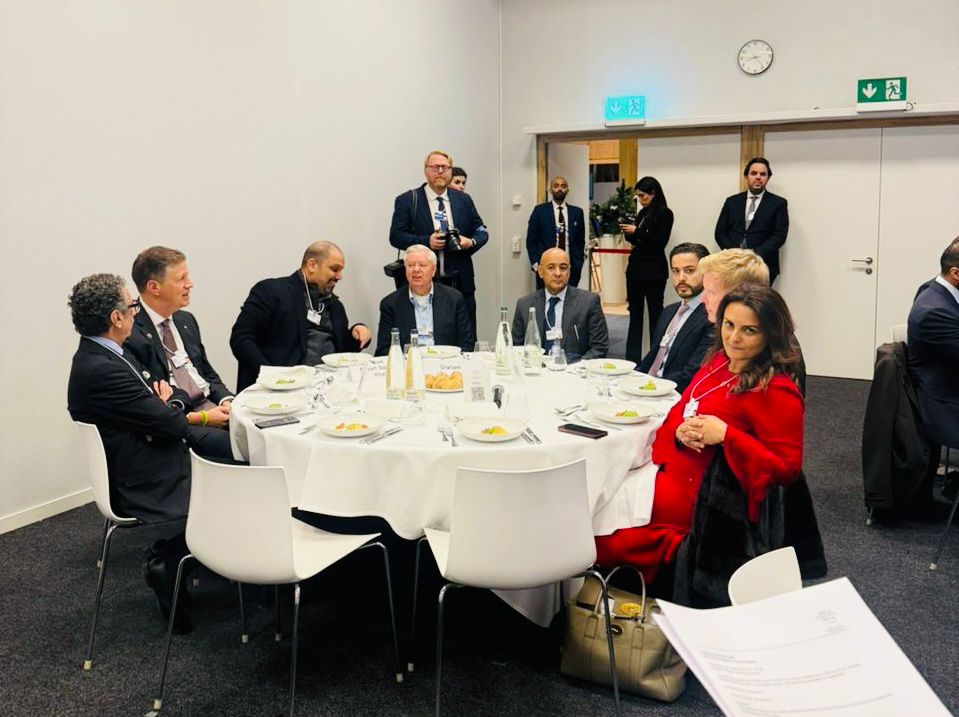
General Secretariat – Davos.
His Excellency Mr Jasem Mohamed Albudaiwi, Secretary General of the Gulf Cooperation Council (GCC), underlined that dialogue and integration are the vital foundations for ensuring stability and security both regionally and globally amidst the current landscape of regional and international transformations.
This statement was delivered during His Excellency’s keynote address at the annual dinner titled “Who Writes the Next Chapter for the Middle East and North Africa”, held on Wednesday, January 21, 2026, in Davos, Switzerland, on the sidelines of the 56th Annual Meeting of the World Economic Forum.
His Excellency explained that the true challenge facing the region is not merely identifying the actors shaping its future, but rather defining the methodology by which that future is constructed. He noted that the international community faces a critical choice between the paths of confrontation or cooperation, fragmentation or integration, and short-term fixes versus long-term visions rooted in collective responsibility.
Addressing these challenges,His Excellency highlighted the GCC’s balanced and comprehensive approach, which combines preventative diplomacy and political mediation with the promotion of economic integration to foster shared interests.
"Despite the surrounding geopolitical complexities, the Council has remained a proactive force for stability, guided by established principles that include respect for state sovereignty, good neighbourliness, non-interference in internal affairs, and the prioritisation of dialogue as the primary mechanism for resolving disputes," His Excellency underscored.
Furthermore, His Excellency Mr Albudaiwi stated that since its inception, the GCC has consistently invested in building effective regional and international partnerships.
"The Council currently maintains structured relations with more than 23 countries and 8 regional and international organisations through various memoranda of understanding, joint action plans, and economic frameworks. These partnerships are specifically designed to support stability while achieving sustainable growth and mutual benefit for all parties involved," His Excellency explained.
His Excellency reaffirmed that the leaders of the GCC member states continue to script the upcoming phase of development with a strategic vision and a sense of collective responsibility. "This vision aims to consolidate regional stability, enhance joint action, and uphold the values of cooperation to safeguard the interests of the GCC peoples while contributing to the security and prosperity of the wider world," His Excellency stated.
In a concluding call to action, His Excellency stressed that while the GCC remains committed to these fundamental principles, it expects regional and international partners to assume their own responsibilities.
He urged these partners to demonstrate a genuine commitment to supporting peace and reaching permanent resolutions to existing regional conflicts. He concluded by noting that while modern challenges make the task of "writing the future" increasingly complex, a steadfast belief in constructive engagement remains the most viable path toward achieving shared goals.